6th–8th Grade | 6th - 8th Grade Academics | City and Country School, New York
Alert
Info
Learning in 6th-8th Grade
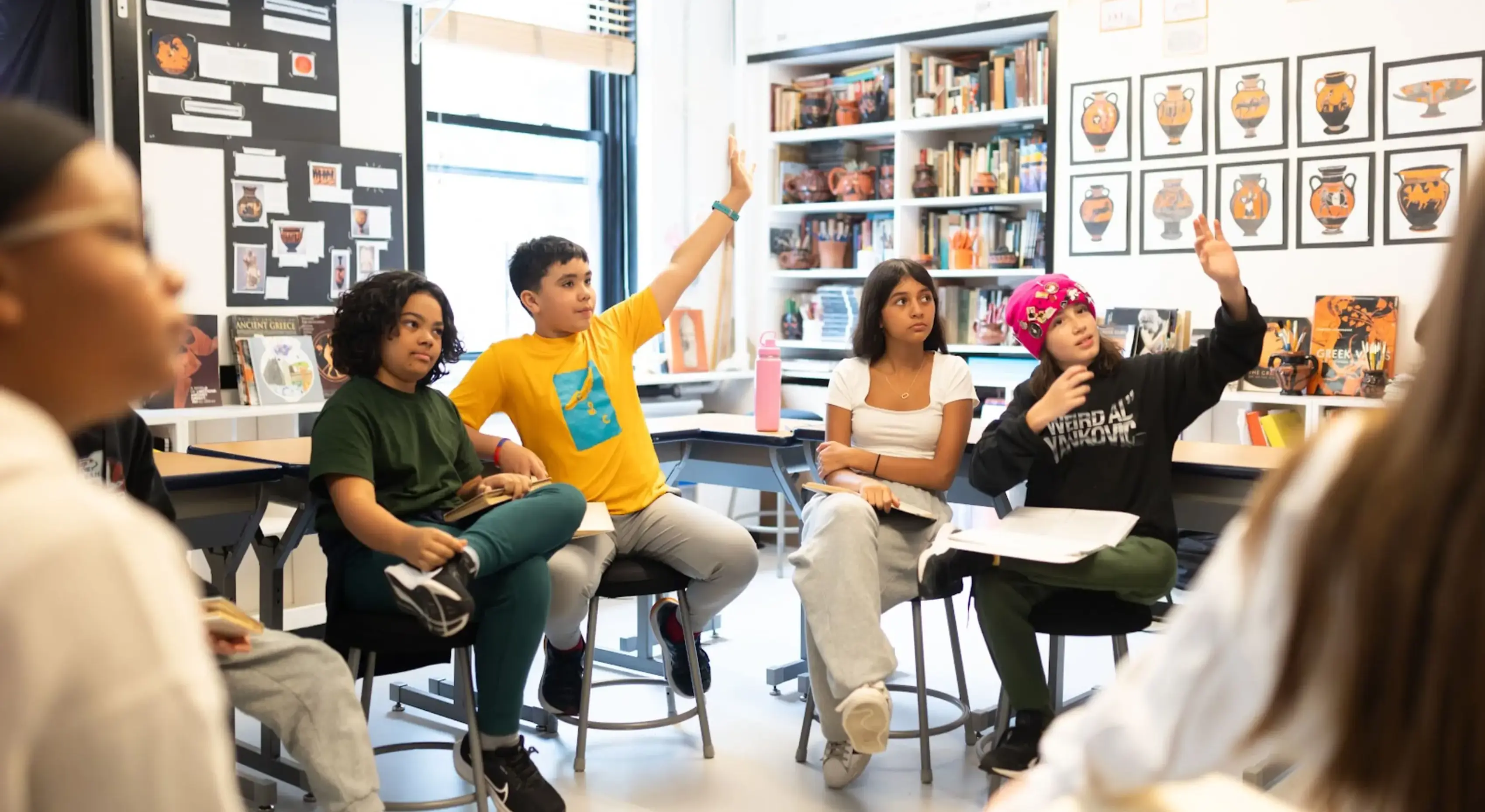
In the XIs through XIIIs, students engage in advanced, interdisciplinary studies that challenge their hunger for grappling with life’s greater questions. Our Upper School students arrive primed with the knowledge of how society works and compelled to examine themselves and their own role within their larger community. These years emphasize independent inquiry, leadership, and real-world application, with a strong focus on critical thinking, self-advocacy, and ethical responsibility. Our Upper School students employ the independence they have cultivated throughout their entire C&C experience, taking on significant leadership roles within the Jobs Program that sustain and guide the school community and synthesizing their learning through self-directed projects, presentations, and reflections that celebrate their growth. The XIIIs year culminates in a powerful capstone opportunity - a trip to the American South - where students see themselves as a part of our history and contemplate how they will shape our collective future, cementing their own readiness for the next stage of their academic and personal paths in high school and beyond.
UPPER SCHOOL · XIs–XIIIs
Explore the curriculum
Choose a subject to discover how learning comes to life.
Social Studies
Social Studies remains the hub through which all academic disciplines flow. Upper School students apply their understanding of daily life across time and place to analyze and unpack the connective themes of humanity - past and present. They explore complex topics, engage with multiple perspectives, and present findings thoughtfully. From the Global Renaissance in the XIs, the Americas and the arrival of European Empires in the XIIs, and contemporary American history through the lens of historically marginalized groups in the XIIIs, our Upper School students examine and interrogate recurring themes of humanity - identity and culture, progress and innovation, trade and economics, power and liberation - and the historical legacies of our collective past.
English Language Arts
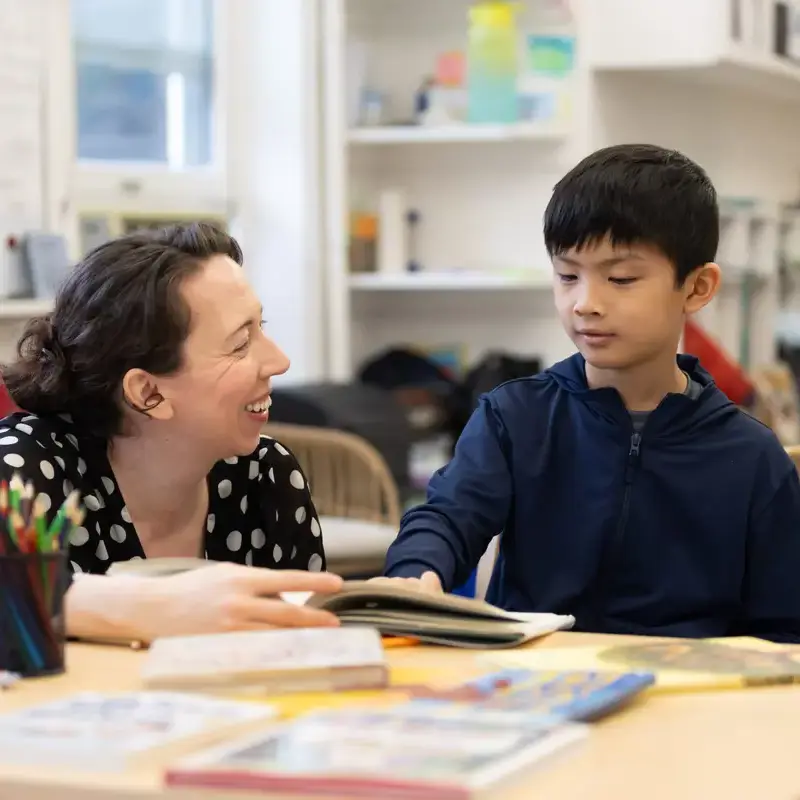
Upper School students apply advanced comprehension skills to analyze scholarly academic research and interpret works of both classical and contemporary literature in connection to their Social Studies inquiries. A rich balance of primary and secondary sources, peer-reviewed scholarly texts, and complex literature supports our students in becoming well-rounded, critical readers, and researchers. Over the years, anchor texts may include 1001 Nights and Daughter of Venice in the XIs, The Absolutely True Diary of a Part-Time Indian in the XIIs, and Black Boy and The Bluest Eye in the XIIIs. Beyond research-driven reading, our Upper School students continue to read for pleasure each day in our Library, further cultivating a sense of themselves and their interests as readers. Upper School students discuss their readings robustly in a variety of contexts - novel study conversations, conferences with our school librarians, Social Studies discourse, collaborative research presentations, and book reviews and recommendations in the XIIIs Newspaper.
Math
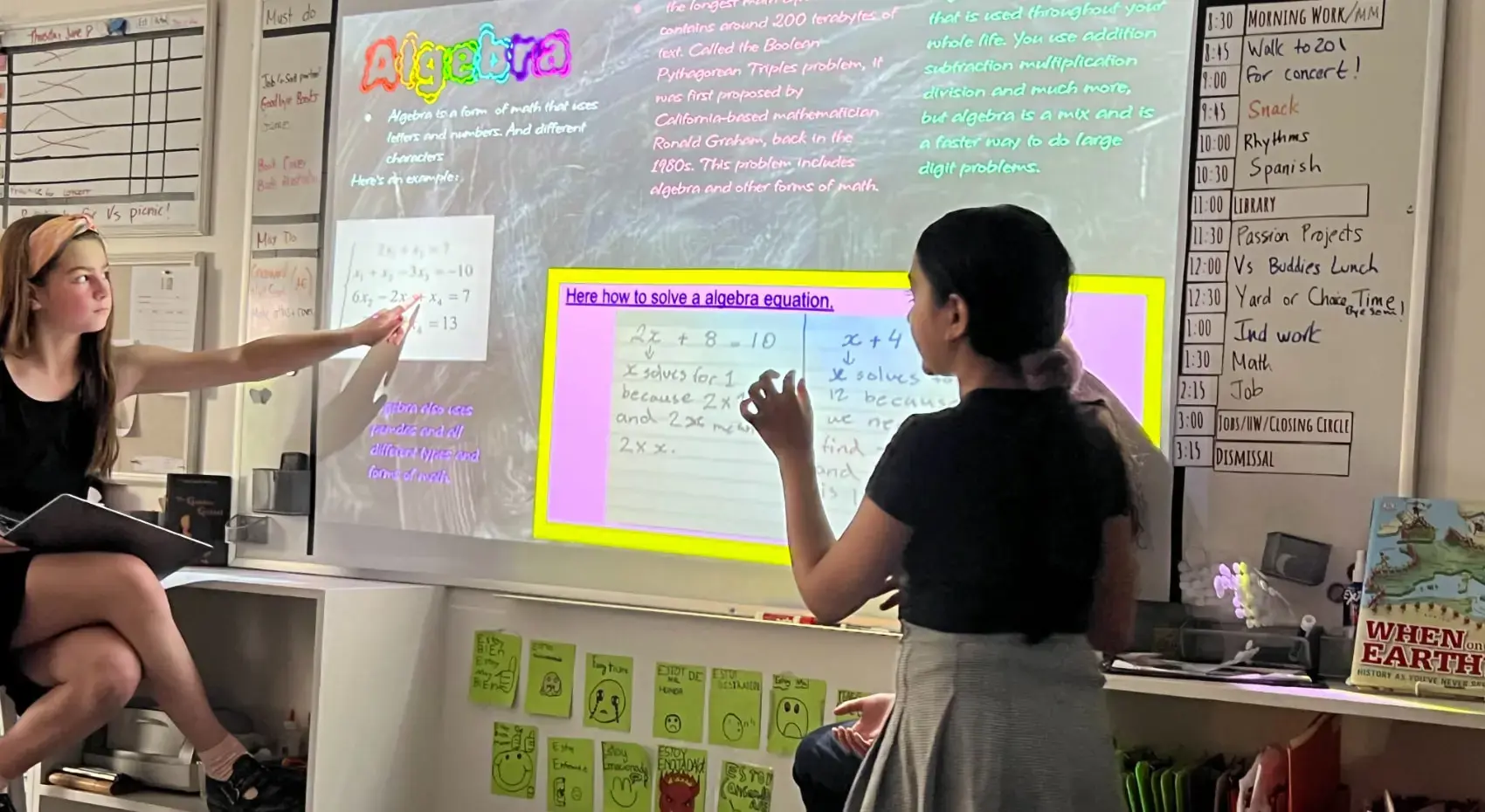
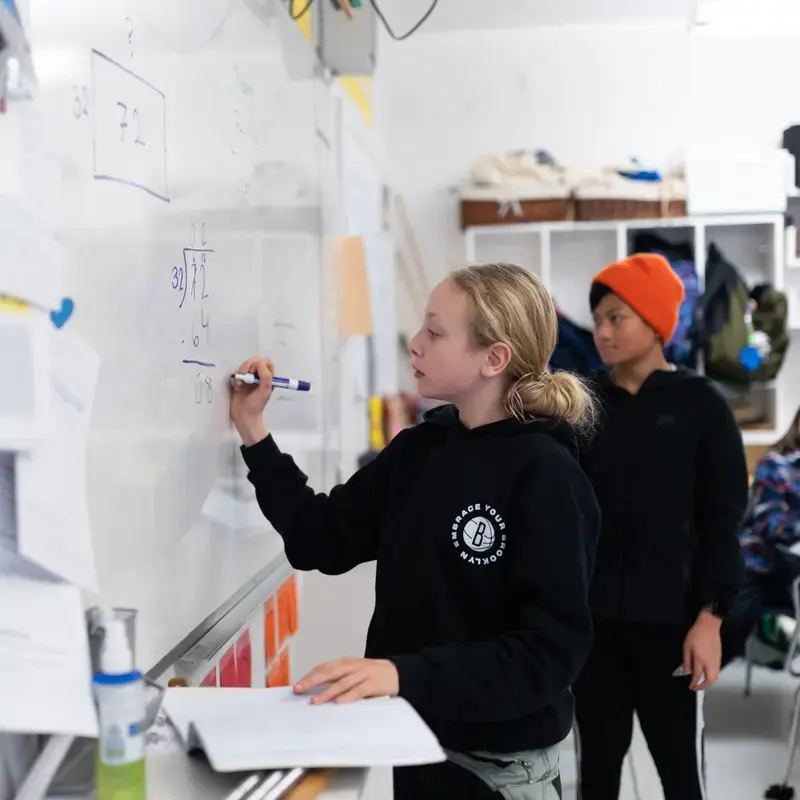
In the Upper School, we balance teaching mathematical concepts through applied problem-solving and explicit procedural practice. Continuing with the Illustrative Mathematics Curriculum, students engage with advanced coursework in the XIs and XIIs that builds deep mastery of pre-algebra and algebra concepts including scale and proportional relationships, linear equations, functions, data interpretation, and probability. In addition to daily math instruction with a math specialist, integrated applications of mathematical concepts—such as critical analysis of statistics cited in academic texts or graphing data for service learning projects around food insecurity —help students see the relevance and necessity of mathematical reasoning. Throughout language-rich math classes, students are encouraged to make mathematical conjectures and defend their ideas with well-reasoned connections to math concepts as well as thorough problem solving. By the end of the XIIIs, all City and Country students complete Algebra I concepts and skills, enabling them to tackle advanced math in high school.
Student Support
The Upper School Student Support Team at C&C is designed to support children, teachers, and families. Composed of full-time Learning Specialists, the School Psychologist, School Nurse, and Division Directors, this group gets to know each student incredibly well and ensures that they are being supported and challenged effectively. Guided by each student's unique learning profile, our learning specialists provide direct instruction in a course called Academic Performance Lab (APL) that helps solidify executive functioning and test-taking skills, while developing a strong ability to self-advocate. APL also includes a study of learning itself–how the brain functions as we learn and grow. At every turn, C&C fosters open communication and this group is no exception. We believe in addressing specific challenges early through observation, support within and outside of classrooms when appropriate, and consistent collaboration. Our goal is to understand and meet each child where they are, recognize their strengths and vulnerabilities, and support them to be their best selves both independently and as part of a group.
Social Studies
Social Studies remains the hub through which all academic disciplines flow. Upper School students apply their understanding of daily life across time and place to analyze and unpack the connective themes of humanity - past and present. They explore complex topics, engage with multiple perspectives, and present findings thoughtfully. From the Global Renaissance in the XIs, the Americas and the arrival of European Empires in the XIIs, and contemporary American history through the lens of historically marginalized groups in the XIIIs, our Upper School students examine and interrogate recurring themes of humanity - identity and culture, progress and innovation, trade and economics, power and liberation - and the historical legacies of our collective past.
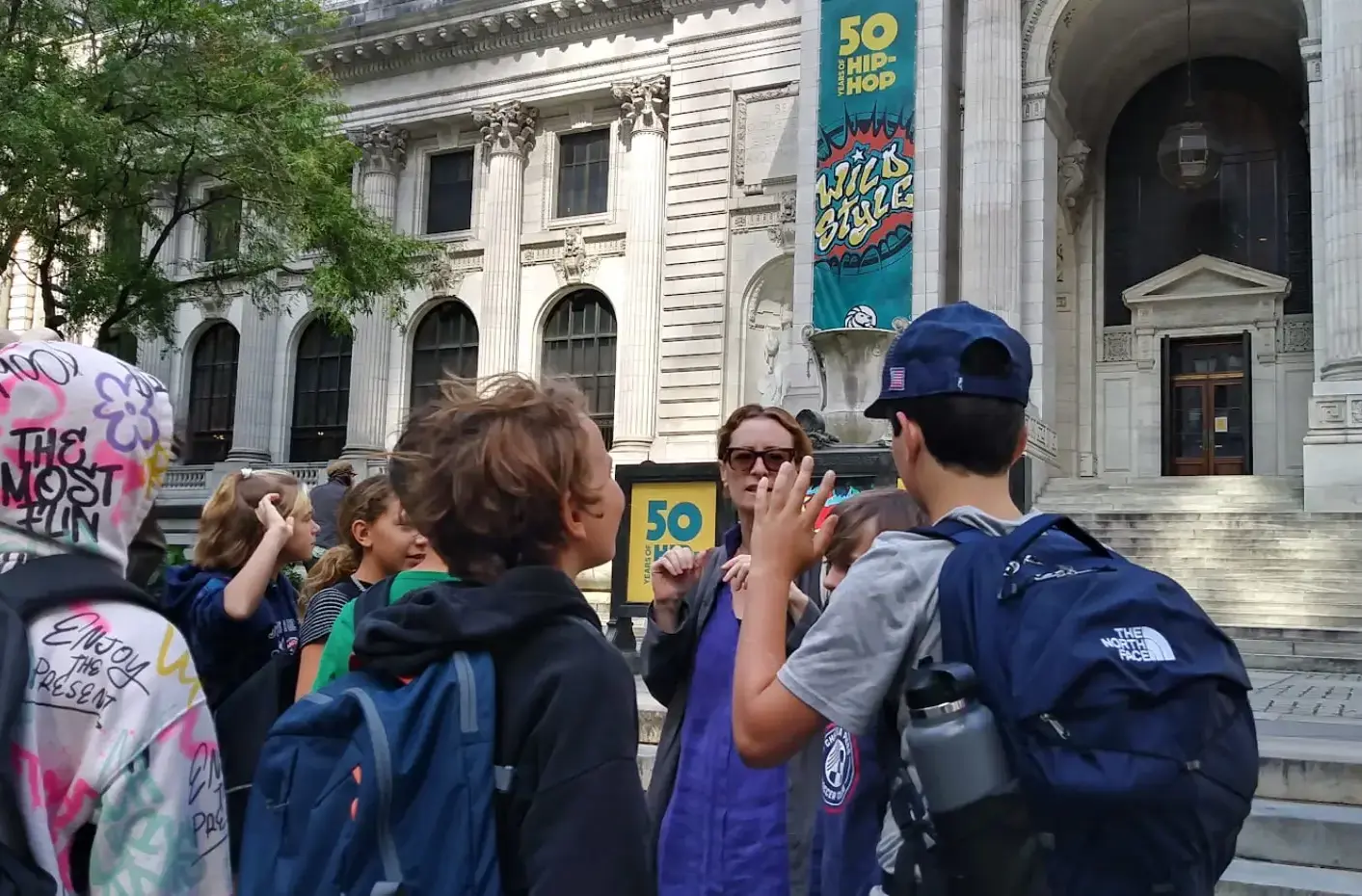
Across the Upper School, students undertake in-depth historical studies and civic activities that connect past and present, anchored in high level academic research, collaborative projects, debates, and experiential learning. Emphasis is placed increasingly on scholarly research. Students work in partnership with their teachers and our research librarian to access academic databases, while continuing to seek out knowledge through a variety of other primary sources such as documentaries, experts in the field, museums, and historical societies. Research is integrated across disciplines (reading, math, science, the arts) encouraging students to observe the interconnected nature of the concepts and themes they study. Upper School students recognize that information is gathered in order to be shared and to impact the world around them, thus, they work to share their research through writing, presentations, and community service.
English Language Arts
Upper School students apply advanced comprehension skills to analyze scholarly academic research and interpret works of both classical and contemporary literature in connection to their Social Studies inquiries. A rich balance of primary and secondary sources, peer-reviewed scholarly texts, and complex literature supports our students in becoming well-rounded, critical readers, and researchers. Over the years, anchor texts may include 1001 Nights and Daughter of Venice in the XIs, The Absolutely True Diary of a Part-Time Indian in the XIIs, and Black Boy and The Bluest Eye in the XIIIs. Beyond research-driven reading, our Upper School students continue to read for pleasure each day in our Library, further cultivating a sense of themselves and their interests as readers. Upper School students discuss their readings robustly in a variety of contexts - novel study conversations, conferences with our school librarians, Social Studies discourse, collaborative research presentations, and book reviews and recommendations in the XIIIs Newspaper.
Writing takes center stage in the Upper School, where students communicate their textual analysis and research findings through expository and argumentative essays. Throughout an interactive writing process, Upper School students consider structure, tone, and other craft elements to elucidate and elevate their ideas. They apply those skills within a variety of works across content and discipline, but always connected to the studies and interests of the students. Examples include, research essays conveying the significance of Renaissance architecture and city planning, scientific reports about the developmental stages of four-year-olds in connection with the XIIs/IVs mentor job, literary analysis connecting themes across texts and comparing and contrasting works of literature from different authors, argumentative essays synthesizing the legacy of historical events in connection current day social issues, and a script full of multiple story lines for their culminating end-of-year Play. In the Upper School, our students grow into skillful writers capable of communicating complex ideas to any audience.
Math
In the Upper School, we balance teaching mathematical concepts through applied problem-solving and explicit procedural practice. Continuing with the Illustrative Mathematics Curriculum, students engage with advanced coursework in the XIs and XIIs that builds deep mastery of pre-algebra and algebra concepts including scale and proportional relationships, linear equations, functions, data interpretation, and probability. In addition to daily math instruction with a math specialist, integrated applications of mathematical concepts—such as critical analysis of statistics cited in academic texts or graphing data for service learning projects around food insecurity —help students see the relevance and necessity of mathematical reasoning. Throughout language-rich math classes, students are encouraged to make mathematical conjectures and defend their ideas with well-reasoned connections to math concepts as well as thorough problem solving. By the end of the XIIIs, all City and Country students complete Algebra I concepts and skills, enabling them to tackle advanced math in high school.
Student Support
The Upper School Student Support Team at C&C is designed to support children, teachers, and families. Composed of full-time Learning Specialists, the School Psychologist, School Nurse, and Division Directors, this group gets to know each student incredibly well and ensures that they are being supported and challenged effectively. Guided by each student's unique learning profile, our learning specialists provide direct instruction in a course called Academic Performance Lab (APL) that helps solidify executive functioning and test-taking skills, while developing a strong ability to self-advocate. APL also includes a study of learning itself–how the brain functions as we learn and grow. At every turn, C&C fosters open communication and this group is no exception. We believe in addressing specific challenges early through observation, support within and outside of classrooms when appropriate, and consistent collaboration. Our goal is to understand and meet each child where they are, recognize their strengths and vulnerabilities, and support them to be their best selves both independently and as part of a group.